
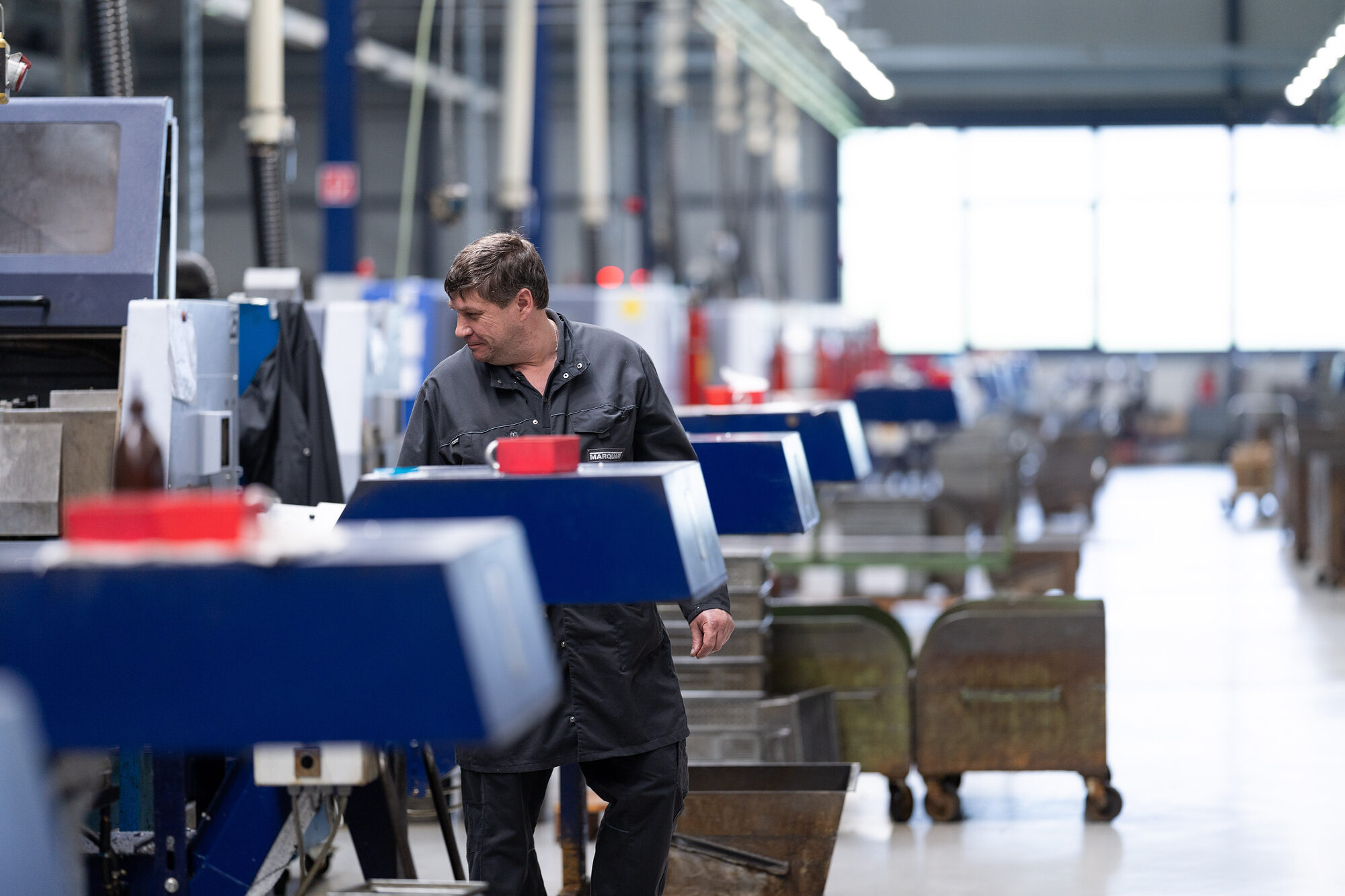
From connection fittings to plug connectors – where brass plays to its strengths.
Brass remains the standard in the turned parts market for electrical contacts, hydraulic fittings and plain bearings. Which grade makes sense when – and why CuZn39Pb3 cannot simply be replaced by alternatives.
Brass Turned Parts: Applications, Material Variants, Economics
Brass alloys are the materials of choice when electrical conductivity, corrosion resistance in water, good sliding properties or thermal requirements come together. This article walks you through the most important brass variants for CNC turned parts.
Brass is a copper-zinc alloy with a long tradition in turned parts. Its wide adoption comes down to three properties: excellent machinability, high corrosion resistance in non-critical media and good electrical conductivity. For CNC contract turning shops, brass is a material that delivers very good results economically.
The dominant grade in everyday industry is CuZn39Pb3 (material no. 2.0401). Roughly 39 % zinc, 3 % lead as a chip breaker. The best machinability of all brass grades, a low material price, and very good corrosion resistance in water and against atmospheric influences. It is used for connection fittings, plug connectors, small hydraulic parts and special nuts.
For lead-free applications (drinking water, food contact, RoHS requirements) there are alternative grades. CuZn21Si3P (material no. 2.0510, also known as 'Eco Brass') is lead-free with a silicon content and machines well. CuZn37 (2.0321) is another lead-free variant with somewhat reduced machinability. These grades are considerably more expensive and are used selectively – not as a blanket replacement for CuZn39Pb3.
Bronze alloys are a material group of their own. CuSn8 (2.1030, tin bronze) is the standard choice for plain bearings – very good sliding properties, good wear resistance under load. CuSn12 (2.1052) is used for more heavily loaded sliding applications. Bronze is significantly more expensive than brass and is only used when the sliding function justifies the extra cost.
Economically, a brass turned part is usually cheaper than a stainless steel part of the same geometry. The better machinability reduces machine time considerably – often 30–40 % less than with 1.4305. The material price is similar to or slightly above stainless steel, but the time savings dominate in most cases.
A practical note: brass chips are chemically valuable – we separate them by grade and pass part of the scrap proceeds back to our customers. For larger series this can be a measurable cost factor. For initial inquiries involving brass, we raise this explicitly.
Dezincification is a key criterion in material selection. In chloride-containing, acidic or soft waters, zinc leaches out of classic brass grades such as CuZn39Pb3 (2.0401), leaving behind porous copper with no strength. On top of that comes the risk of stress corrosion cracking, for instance under exposure to ammonia. For such media, we use dezincification-resistant grades such as CuZn36Pb2As (2.0375), the so-called DZR brass. The arsenic addition inhibits dezincification. This becomes relevant wherever components carry water permanently.
For plug and contact applications, electrical conductivity is the decisive factor. Depending on the alloy, brass achieves only about 15 to 28 percent of the conductivity of pure copper, but offers spring properties and good machinability, which is why it is widely used for terminals, sockets and threaded contacts. Where maximum current-carrying capacity matters, such as power contacts or busbars, pure copper Cu-ETP (2.0065) is the better choice. If machining is also required, free-machining CuTeP (2.1546) with a tellurium addition is recommended, combining high conductivity with good turnability.
For use in drinking water contact, the German UBA assessment basis for metallic materials applies. Only alloys listed on the corresponding positive list of the German Environment Agency (Umweltbundesamt) may be used for components with permanent drinking water contact. Leaded brass such as CuZn39Pb3 is ruled out here, since lead can migrate into the water and the permissible limits would be exceeded. For such applications we turn from listed low-lead or lead-free grades. We document the material provenance through 3.1 material certificates to DIN EN 10204.
Brass is an excellent base material for electroplated finishing. Chemical or electrolytic nickel plating with a typical coating thickness of 5 to 15 µm acts as a diffusion barrier, prevents zinc from migrating to the surface and provides reliable corrosion protection. On top of that, a thin chromium layer of a few tenths of a µm can be deposited for a visually high-quality, scratch-resistant surface. The homogeneous, easily wetted brass surface takes the coatings evenly and rarely shows adhesion defects. Before coating, we make sure of burr-free, well-defined turned surfaces so the coating builds up cleanly.
The key takeaways.
- 01CuZn39Pb3 = standard brass, best machinability, very economical. Not for drinking water/food contact.
- 02Lead-free alternatives (CuZn21Si3P, CuZn37) for drinking water/food/RoHS. Considerably more expensive.
- 03CuSn8 bronze for plain bearings with high wear requirements.
- 04A brass turned part is usually 20–30 % cheaper than a stainless steel part of the same geometry (better machinability).
- 05Chip scrap credits can be significant for larger series – raise it in the quote.
FAQ on this topic.
Which brass grades do you keep in stock?+
Can you have brass turned parts electroplated?+
How economical are small brass batches?+
Is brass suitable for high-temperature applications?+
Are brass turned parts FDA-compliant?+
Can you also produce small special threads in brass?+
Your drawing on our desk.
We check feasibility, suggest optimizations and get back to you within 48 hours with a first assessment.