
Where the unit price can be pushed down without losing function.
Small geometry changes can lower the unit price by 10–15 %. Five concrete levers we see again and again.
Optimizing Series Production: 5 Levers from 77 Years of Practice
If you order turned parts in series, you rarely have leverage on the unit price directly – but you do on its building blocks. These five levers come up again and again in our first article reviews and save significant costs on larger series. Compiled from 77 years of turned-parts practice.
Lever 1 – Clean up the tolerancing: Take a drawing in hand once and set all non-functional dimensions to DIN ISO 2768 medium, and you save 10–20 percent unit price on most parts. In a typical turned part, two to four diameters are functional – the rest can live with general tolerances. We break down the details in the article 'Understanding Tolerances'.
Lever 2 – Question the material: V4A (1.4571) where V2A (1.4305) is enough is one of the most common sources of unnecessary premium. Quenched and tempered steel where free-cutting steel would do is another. Blanket specifications from the material catalog without functional justification are widespread in design – and expensive.
Lever 3 – Simplify the geometry: Every additional geometry move in the NC program costs machine time. Contours that look 'nice' in the design but are functionally equivalent to a simpler geometry are classic cost traps. Example: a plunge-cut run-out geometry (G-code effort: 15 seconds per piece) versus a 0.5 mm undercut (G-code effort: 2 seconds). On a series of 10,000: 36 hours of machine time difference.
Lever 4 – Optimize the lot size: If you order 250 pieces monthly, you pay setup costs spread across 250 pieces. If you order 750 pieces quarterly, you pay the same setup costs spread across 750 pieces. That lowers the unit price by 5–15 percent on many parts. Counter-question: what does the additional inventory cost the buyer? Frequently much less than the setup cost savings.
Lever 5 – Bundle parts: If you inquire about several turned parts with one supplier, don't treat them individually. Material bundling (the same material for several parts reduces the supplier's inventory costs), machine sequencing (two similar parts run back to back on the same machine reduces setup costs) and administrative bundling (one collective order instead of three individual orders) add up. In practice we see 3–8 percent savings on bundled inquiries.
These five levers don't work in isolation. They are a system – tackle all five at once and you reach 15–30 percent total savings on larger series. That requires open communication between design, purchasing and the supplier. We do this regularly with our regular customers – usually in a one-day DFM review at project start.
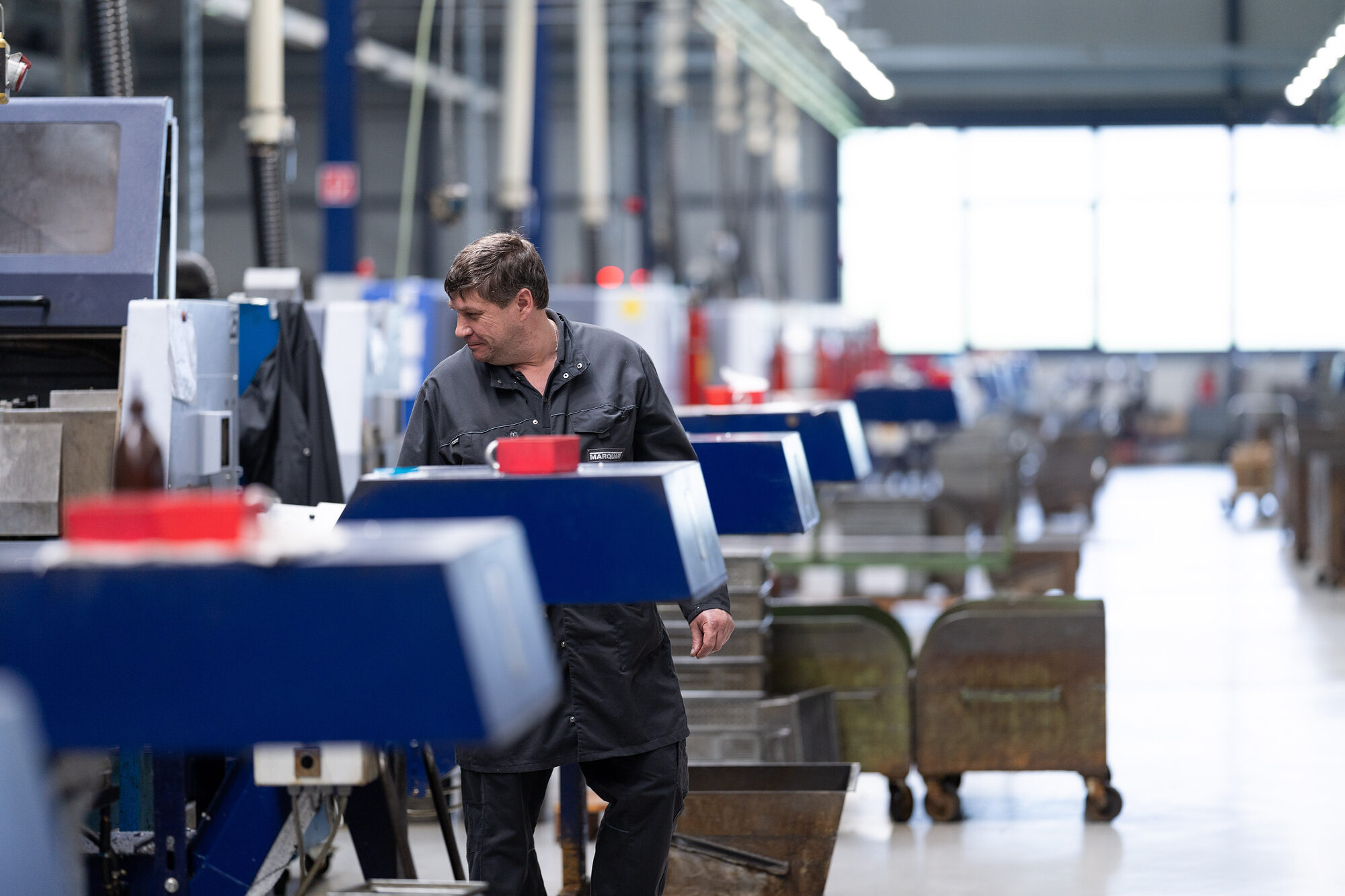
For robust series, the machine-hour share per part can be lowered noticeably when the automatic lathes run unattended overnight. The prerequisite is a bar loader that feeds our CNC automatic lathes with material up to Ø 42 mm for hours without operator intervention, combined with reliable chip management and chip conveyors that safely remove stringy chips. Monitored processes with tool breakage detection and dimensional monitoring safeguard quality even in the unattended shift. Setup and fixed costs then spread across far more parts, and the unit price drops without compromising repeatability.
In high-volume production, tool life decides scrap and downtime. Constant cutting parameters – steady cutting speed, feed rate and coolant supply – keep wear predictable and dimensional accuracy stable across the entire batch, especially with IT6 tolerances or reproducible Ra 0.4. A sister-tool strategy ensures the machine automatically switches to an identically preset second tool when the defined tool life is reached, instead of stopping. That avoids dimensional drift shortly before breakage, reduces rework and keeps the line running productively through the night shift.
For plannable demand we recommend a framework agreement with staggered call-offs. You release the annual quantity bindingly and thereby secure the lower large-series unit price, but call off the parts in partial lots – monthly or quarterly, based on your actual consumption. That combines the costing advantages of a large lot size with your purchasing department's liquidity and warehouse flexibility: no capital tied up in full shelves, no recurring setup costs per order. You plan your demand cleanly once, and we reserve material and machine capacity accordingly.
Packaging and preservation also hold savings potential in series. Stackable returnable packaging with a defined quantity per container speeds up your goods receipt, simplifies count checks and avoids packaging waste with every delivery. Corrosion protection should be applied as needed rather than across the board: parts made of stainless 1.4404 usually need no oil preservation, while free-cutting steel is protected specifically for longer storage or sea freight. That way you only pay for the protection the part actually needs, and save on material, cleaning effort and disposal across the entire series.
The key takeaways.
- 01Clean up tolerances (10–20 % savings): functional diameters tight, the rest to DIN ISO 2768 medium.
- 02Question the material (5–15 %): V2A instead of V4A, free-cutting steel instead of quenched and tempered steel where functionally sufficient.
- 03Simplify the geometry (5–10 %): avoid unnecessary NC program steps, optimize run-out geometries.
- 04Optimize the lot size (5–15 %): quarterly ordering instead of monthly where inventory is acceptable.
- 05Bundle parts (3–8 %): use material and machine bundling at the supplier.
FAQ on this topic.
Do you run DFM workshops with regular customers?+
How do we get a first cost comparison for our existing series?+
What if the design engineer doesn't want to change the tolerances?+
Are these levers also worthwhile for small series?+
How much effort is a DFM review?+
Are such workshops worthwhile even without an order?+
Your drawing on our desk.
We check feasibility, suggest optimizations and get back to you within 48 hours with a first assessment.