
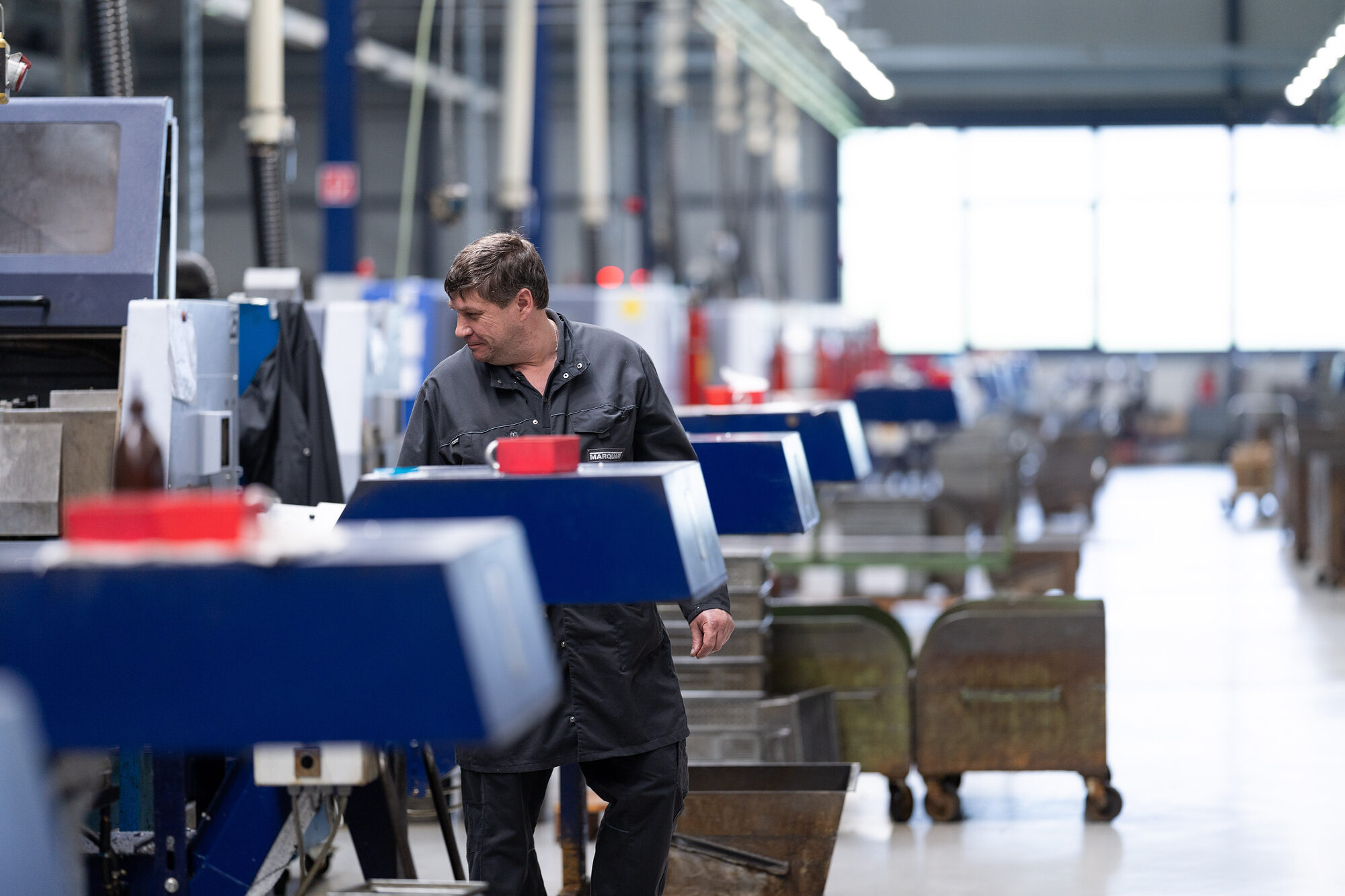
How a 100-year-old Swiss invention manufactures implants today.
Swiss-type turning is the workpiece-guiding variant of CNC turning. The principle originates from the Swiss watch industry – today it manufactures implants and hydraulic components.
The Swiss-Type Principle: Why Swiss-Type Turning Is the Premier Discipline
Swiss-type turning is the workpiece-guiding variant of CNC turning – the workpiece is supported by the guide bushing directly at the machining point. This principle emerged in 1880 in the Swiss watch industry and remains the economically superior process for slender, long precision turned parts to this day.
The classic turning process clamps the workpiece at the spindle head, and the tool moves toward the workpiece. With slender, long workpieces (length-to-diameter ratio > 5), a problem arises: the workpiece deflects under cutting pressure, tolerances fluctuate, surfaces deteriorate, and in extreme cases the workpiece breaks.
The Swiss watchmakers had an elegant solution: clamping happens not at the end of the workpiece but immediately at the machining point. The workpiece is pushed through a rotating guide bushing, and the tool machines the material directly as it exits the bushing. Deflection is mechanically eliminated – the workpiece never hangs freely; it is always supported in the guide.
The result: on a Swiss-type machine, L/D ratios of 30 or more are manageable. Tolerances of IT6 to IT7 are reproducible. Surface finishes of Ra 0.4 are achievable. Components 200 mm long with a 5 mm diameter pose no technical challenge – on a classic lathe they would be uneconomical or impossible.
Modern Swiss-type automatics are highly complex machine tools. Up to three tool slides work simultaneously, a sub-spindle handles back machining in the same setup, and live tooling enables cross holes, milling and polygon machining. What was a pure turning process has become a complete machining cell – the finished part leaves the machine without any further setup.
At Marquart, the Swiss-type automatics run alongside our CNC short-turning automatics in the same plant in Reichenbach am Heuberg. Our production planning team chooses the process based on the specific geometry – we use whichever process is economically superior, without the customer having to commit to one variant.
An economic note: Swiss-type turning is not 'automatically more expensive' than classic turning. With the right geometry, it is faster because fewer setups, fewer correction loops and tighter machine times are possible. With the wrong geometry, it is more expensive than short turning. We discuss this in the first article review.
For the guide bushing, a distinction is made between fixed and rotating designs. The fixed bushing encloses the bar stock with minimal play and suits many standard materials; the rotating bushing turns with the bar and avoids friction marks on sensitive or soft surfaces. In both cases, quality stands or falls with the raw material. The bar must be tightly toleranced in diameter, straight, and cleanly peeled or ground, because only then does the bushing guide the material smoothly and without runout directly at the machining point.
A second lever is multi-channel machining. Modern Swiss-type automatics have several tool carriers that cut simultaneously together with the main and counter spindle. While the front slide turns a contour, another tool is already machining a cross or longitudinal hole, and the counter spindle handles the back side in parallel. This overlapping of operations significantly reduces the main machining time per part without compromising accuracy. Especially for feature-rich geometries with holes, threads and milled features, throughput time shrinks considerably.
This is what turns the process into a true high-volume machine. Bar feeders supply the material automatically, so the automatics run unattended for hours, including night and weekend shifts. Remnant material is ejected and handled in a controlled manner, and continuous process monitoring detects tool wear or dimensional deviations early. The result is a stable, reproducible process that delivers high quantities at IT7 and Ra 0.4 economically. Swiss-type turning is thus not just a precision tool for individual parts but a productive series production solution.
The process does have clear limits, however. Short parts with a large diameter can hardly be guided sensibly through the bushing, because the long remnant at the bar end worsens material utilization. Heavily interrupted cuts, for example across cross holes or slots, stress the guide and the tool. And geometries that do not allow uniform feeding through the bushing are ruled out anyway. In such cases, short turning – available in the same plant up to Ø 42 mm – is the technically and economically right choice.
The key takeaways.
- 01Swiss-type principle: workpiece support directly at the machining point – ideal for L/D > 5.
- 02Originated in the Swiss watch industry in 1880, today the standard in medical technology and precision mechanics.
- 03Tolerances of IT6/IT7 and Ra 0.4 reproducible – without downstream grinding.
- 04Modern machines with sub-spindle and live tooling machine parts completely in one setup.
- 05The manufacturer chooses the process based on the geometry – no need for a blanket 'Swiss-type or short-turning order'.
FAQ on this topic.
What is the difference between Swiss-type and classic turning?+
Which parts typically belong on Swiss-type machines?+
What maximum diameter do you machine on Swiss-type?+
Can you also do cross holes and milling operations?+
What is the economic boundary between Swiss-type and short turning?+
Which materials do you process on Swiss-type machines?+
Your drawing on our desk.
We check feasibility, suggest optimizations and get back to you within 48 hours with a first assessment.