
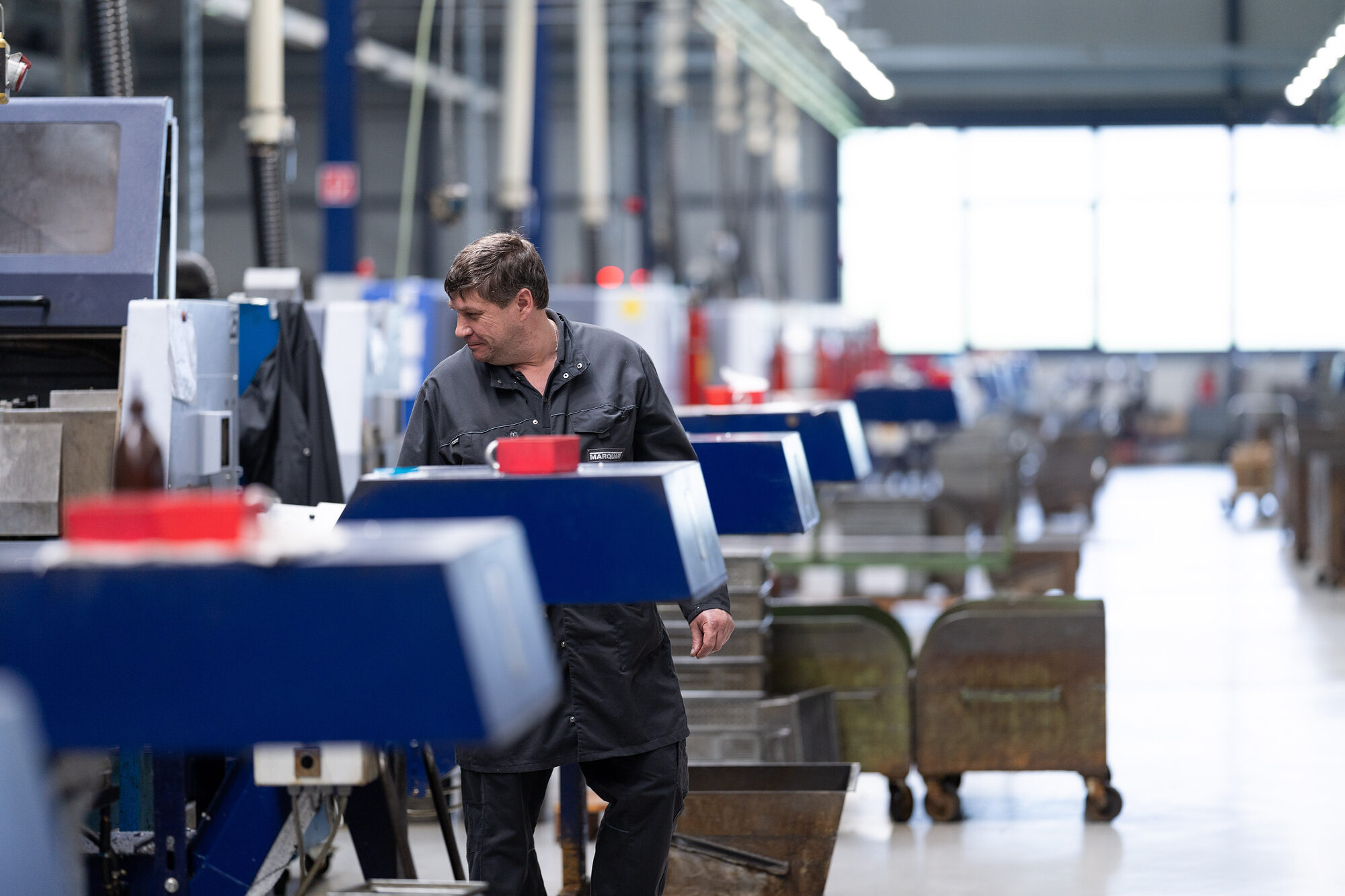
Slender parts belong on the Swiss-type lathe. Short, complex ones usually on the fixed headstock lathe.
Slender, long parts are classic Swiss-type territory. We explain the guide bushing principle and when short turning is more economical.
Swiss-Type vs. Short Turning: When Is Which Process Worth It?
Swiss-type turning and short turning are not competing processes but complementary tools of turned-part manufacturing. If you know the strengths of both, you choose the economically right process for every part. This article explains the differences from the machine's perspective – without marketing fluff.
Swiss-type turning is based on a decisive design principle: the workpiece being machined is clamped directly at the guide bushing during cutting. The tool stays stationary while the material is fed forward. This clamping situation has a major advantage – the machining zone sits extremely close to the clamping point. Vibrations, deflections and tolerance deviations that occur with long, slender workpieces on conventional turning processes are largely eliminated.
The result: Swiss-type turning is the process of choice for rotationally symmetric parts whose length is several times their diameter. Stems, spindles, long bushings, contact pins – anything slender and long belongs on the Swiss-type lathe. Typical sweet-spot geometries: Ø 3 to 32 mm, length 30 to 200 mm, often with complex features such as threads, contours, cross holes.
Short turning, by contrast, is the process for compact, often complex workpieces that are geometrically short but require many machining operations. Flanges, bushing assemblies, coupling components, special nuts – parts where the machining time is not concentrated along the length but spread over many different operations on the piece. Modern fixed headstock lathes with live tooling and sub-spindle can finish such parts completely in one setup.
The economic boundary typically runs where the length-to-diameter ratio tips. Rule of thumb: L/D > 3, then Swiss-type turning. L/D < 1.5, clearly short turning. In between, the decision depends on the specific geometry and the quantity. It regularly happens here that we switch a part between processes when the series requirement changes.
A practical advantage when a supplier runs both processes under one roof: you don't have to commit during the inquiry process. We decide from the drawing which process is economically superior – without you having to send out two inquiries. At Marquart, Swiss-type and short turning run in parallel on 35 CNC automatics in the same plant.
A special question comes up often: can parts manufactured by Swiss-type turning also be produced by short turning? Technically yes – but typically with higher unit costs and greater dimensional scatter. The reverse rarely works: complex, short parts are hard to produce economically on Swiss-type automatics.
An often underestimated cost factor is material utilization. In Swiss-type turning, a remnant piece stays in the guide bushing at the end of machining – the so-called clamping remnant – which ties up typically 8 to 15 mm of bar material depending on the bushing design. In short turning, a chuck remnant is lost instead, which is usually larger relative to the more compact part length. For slender parts made of expensive materials such as 1.4404 or titanium alloys, Swiss-type turning therefore pays off through lower scrap per piece alone.
The setup and tooling concept also differs significantly. A Swiss-type automatic works with tools on several linear systems and a counter spindle; the tool layout is denser and the programming has to account for the moving material together with the guide bushing. Setup accordingly takes longer, often several hours. The fixed headstock lathe with turret is set up faster and is more tolerant of geometry changes. If you need small series or sample parts at short notice, you benefit from the shorter setup time of short turning, while the extra effort of Swiss-type turning only pays for itself over the production run.
From this follows the quantity economics. For a few dozen to a few hundred parts, short turning leads because of the short setup. As lot size grows, the balance tips: from roughly 500 to 1,000 pieces, Swiss-type turning plays to its strengths, because slender parts are finished in a single pass and the bar loader enables largely unattended production overnight and on weekends. These unattended run times noticeably lower the unit price and are the real lever for medium to large series.
Finally, back-side machining is decisive for dimensional accuracy and cost. Both machine types hand the part over to a sub-spindle and machine the back side in the same setup, so facing, chamfering or cross holes are done without re-clamping. This avoids a separate setup and clamping operation and keeps concentricity and length dimensions consistently within IT7, with the right strategy even IT6. If the back side had to be re-clamped on a second machine, not only would handling costs add up, but so would clamping errors that degrade the achievable tolerance.
The key takeaways.
- 01Swiss-type turning = workpiece is clamped at the guide bushing → ideal for slender, long parts (L/D > 3).
- 02Short turning = conventional clamping situation → ideal for compact, complex parts (L/D < 1.5).
- 03In the middle range, the specific geometry decides – an experienced supplier costs out both options.
- 04Swiss-type and short turning under one roof saves duplicate inquiries and gives flexibility when the series changes.
- 05Complex short-turning parts are rarely economical on Swiss-type lathes – the reverse only with a cost penalty.
FAQ on this topic.
What is the main advantage of Swiss-type turning?+
Is there a rule of thumb for which process to use?+
What is the maximum diameter you machine in Swiss-type turning?+
Can you also do complex cross holes and milling with live tooling?+
Do customers have to choose between Swiss-type and short turning?+
What is the typical sweet spot of the Marquart machines?+
Your drawing on our desk.
We check feasibility, suggest optimizations and get back to you within 48 hours with a first assessment.